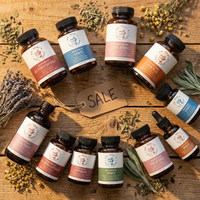


Before It Had a Name
Sea moss and batana didn't start as trends. They came from Caribbean, African, and Indigenous plant traditions, long before the hashtag.
Every few years the wellness world announces a discovery. An exotic fruit. An ancient grain.
A green algae from the sea. A way of eating built around plants and minerals. A category of foods someone decides to call "super." The names arrive with a marketing budget, a hashtag, and a sense that this is new.
It isn't. Not to us, and not to the traditions we come from.
Dr. Sebi built a life's work around whole plants, minerals from living sources, and eating from the plant kingdom — decades before those ideas had trending names attached to them. The traditions themselves are older still: carried out of the Caribbean, off the Miskito coast, through African and Indigenous plant lineages, passed hand to hand and word to word long before any of it was content.
Before It Had a Name is our running record of that. Each entry takes one thing the market recently "discovered" and puts it back in its actual timeline — where it came from, who was already practicing it, and when it entered Dr. Sebi's work. Not to claim we own it. To tell the history straight, from inside the tradition that carried it.
We don't chase trends. The trends catch up.
The record so far:
- Sea Moss — before it had a hashtag → [entry]
- Batana Oil — before the hair-care aisle found it → [entry]
- Elderberry — before the shelves were emptied → [entry]
- Alkaline, plant-forward eating — before it was a diet trend → [entry, forthcoming]
- "Superfoods" — he called them electric → [entry, forthcoming; links Lexicon: Electric Foods]

Sea Moss, Before it Had a Hashtag
Where it actually comes from
Dr. Sebi recommended using Chondrus Crispus. A variety mainly found in cold Atlantic Waters. It's commonly known as Irish Sea Moss as it grows abundantly in Ireland's rocky Atlantic coastline and has a long history of traditional use.
It wasn't discovered by a wellness feed. It was carried by coastal communities who knew it as ordinary, useful, and theirs, long before it had a marketing name.
That's the pattern this whole series is about: a practice lives quietly inside a tradition, doing its work, until the wider market notices it and renames it as new. The renaming is recent. The practice is old.
Why it fit the work
Sea moss is a sea vegetable, and the sea is one of the two places minerals actually come from — the ground and the ocean. A plant, or a sea plant, can only carry the minerals its environment has to give, and the sea moss Dr. Sebi promotes minerals directly from rocks and seawater. That's not a health promise; it's where the material comes from. (More on that idea in [Wild vs. Farmed].)
Whole, mineral-bearing sea vegetables fit the standard Dr. Sebi built his work around: whole plants, minerals in the form Nature carries them, nothing made in a lab. Sea moss belonged in that world naturally — not as a headline, as a fit.
What the trend gets right — and what it flattens
The trend gets one thing right: sea moss is worth paying attention to. What it flattens is everything underneath — the coast it came from, the people who kept it, and the difference between a whole sea vegetable and a long ingredient list read off a label.
Our standard hasn't changed with the feed cycle. Whole sea vegetable, from the sea, prepared to the original standard. Before it had a hashtag, it had a home.
Key Takeaways
- Sea Moss is popular in certain cultures, mainly in the Caribbean and along the Irish coastline — not a recent discovery, only a recent trend.
- It's a sea vegetable; it extracts its nutrients from rocks in the sea.
- It fit Dr. Sebi's whole-plant, whole-mineral standard as a matter of composition, not marketing.
- We tell the history as attribution, not ownership: the tradition is older and bigger than any one brand.

Batana Oil, Before the Hair-Care Aisle Found It
The version you know
Batana oil showed up in your feed as a hair secret. Thick, dark, spooned out of a jar, filmed against good lighting, sold as the new answer to almost anything you could want for your hair.
That's how it arrived to the wider market: suddenly, and as a discovery. That framing skips the part that matters — where it comes from, and who was using it long before it trended.
Where it actually comes from
Batana oil comes from the Miskito coast between Nicaragua and Honduras. The oil is pressed from the nut of a palm and used by the communities there as part of everyday care, carried forward across generations. It wasn't invented by a brand. It was already a living practice — ordinary, useful, and rooted in a specific place and people — for a very long time before it became a product category.
That's the whole pattern of this series. A tradition does its quiet work inside a community until the market notices, renames it, and presents it as new. The attention is recent. The practice is old, and it belongs to the people who help keep it going.
Why it fit the work
Batana fits the same standard everything here is held to: whole, from the plant, prepared the way the tradition prepared it — not reformulated in a lab. It's a botanical oil used on the hair and skin, valued for the way it conditions and nourishes, and for the feel it leaves behind. That's what a good botanical oil does; it's care, honestly named, without turning it into a promise it can't keep.
What the trend gets right — and what it flattens
The trend is right that batana is worth knowing. What it flattens is the coast it came from and the people who kept it — reducing a living tradition to a before-and-after clip. We'd rather celebrate it properly: a Miskito-coast botanical, carried by the community that originated it, used the way it has always been used.
Before it was a hair-care headline, it was already someone's tradition.
Key Takeaways
- Batana oil is a Miskito-coast tradition, pressed from a palm nut and used for generations — not a recent invention.
- It's a whole botanical oil for the hair and skin: conditioning, nourishing, for the feel of comfortable skin and hair.
- It fits the whole-plant standard as a matter of what it is, not marketing.
- We name it as attribution: the tradition belongs to the community that carried it.

Elderberry, Before the Shelves Emptied
The version you know
Most people met elderberry the same way: as a syrup that sold out. For a stretch, it was everywhere and then nowhere — the jars gone from the shelf, the demand well ahead of the supply. That surge is the version of elderberry a lot of people carry in their heads.
That moment was real. It also wasn't the beginning of the story.
Where it actually comes from
Elderberry has a long history of traditional use that runs back through generations and across continents — a dark berry from the elder plant, prepared and passed down as part of folk practice in many cultures long before it had a modern market. The recent demand surge was a chapter, not the origin. The plant, and the practice of using it, were here first.
Why it fit the work
Elderberry is a whole plant, used in whole-plant form — which is the entire point of the standard this work is built on. Nothing made in a lab, nothing reduced to an isolate: the berry as the plant carries it. That's why it sits comfortably in a tradition that has always favored the whole plant over the extracted compound.
What the trend gets right — and what it flattens
The surge got one thing right: people reached for a plant, in its whole form, and reached hard. What it flattened was the long history underneath the moment — centuries of traditional use compressed into a single sold-out season. We'd rather keep the whole timeline visible: a plant with deep roots in folk practice, valued long before, and still, for being exactly what it is.
Before the shelves emptied, elderberry already had a history.
Key Takeaways
- Elderberry has a long history of traditional use across many cultures — the recent surge was a chapter, not the start.
- It's used in whole-plant form, which fits the whole-plant-over-isolate standard.
- We tell it as history and market context, not as a discovery or a claim.